Showing posts with label RPGs. Show all posts

Saturday, August 17, 2024

Dungeons and Dragons: A Drunken Rant!

Its been a while since I last posted anything. This is mostly about 5e D&D.

Fuck you Tolkienesque races! While I know they are iconic to D&D, I'm not obligated to run a Middle Earth setting, nor am I obligated to have them in my setting. Also, holy hell! Every new fantasy RPG have some flavor of Elf, Dwarf and Halfling, and worst have a ton of variation of them. Each and everyone of one of them are one bland stereotype after another! If your setting has five or more versions of "Elf" (or equivalent) your setting... is... shit!

Tonally, my fantasy setting are a mix of Conan- and Elric-styled Sword & Sorcery with Sword & Saddles, so humans are predominant. Non-human people are rare and are generally alien in thinking. The one exception I make are dark elves. Namely, a Drow-like race modeled on Elric of Melniboné. A degenerate race of pale, amoral sorcerers and slavers who once controlled the world but are now dying off. But don’t call them "elves" as they are not fay. Gnomes are small rock-people. Dwarves, elves and fairies are of old folklore and are scary, amoral supernatural freaks of nature.

Fuck you Paladin! You white-knight motherfucker! I never liked alignment and you are inescapably tied to it! The only good thing Wizards did with you is brake you from your Lawful Good restriction. But I never liked you! The way you have to be moralistic ALL THE FUCKING TIME! I hate your divine power of abject goodytwoshoeness! Fuck, I remember when you could not get ANY disease. Could you even shit back in the 2e era? Did you fart lavender? If your 'lay-on-hand' could heal wounds, what would a healing handjob do? I have no time to fuck around with your Born Again bullshit! I would not mind you so much back in the 3e day, but you were a core class. There is a problem with that: You were meant to be a 'sub-class' of Fighter. Well, more like an enchanted Fighter with a lot of powerful options with the restrictions that comes with it. If you fail to live up to your mile-high standards, you loose your abilities and become a basic-bitch Fighter, and must redeem yourself to become a Paladin again. If anything, you should have been a Prestige Class of fighter. That is, you must work for it and work to keep it!

But still, you were never a tonal-fit for my settings. Fuck your Camelot bullshit! Fuck off!

Fuck you Ranger! You never made sense. What the fuck are you? When I think "Ranger", I think of a rugged frontiersmen like Daniel Boone or David Crockett, or a feral child like Tarzan or Dar from The Beastmaster. So where do all the spell-casting comes from? Is there a Wizarding School in the jungle? "Me Tarzan of House Muffleduff." Fuck that noise! Also, why are Rangers so much better at survival than Barbarians? Barbarians are native people deeply connected to the untamed land they families hailed from. Rangers (the non-feral types) are colonizers from civilized stock. What white-savor bullshit is this?

I have no issue with Rangers being in the game, but they need to be a Fighter archetype with scaled down abilities, they get no animal companion, and THEY CANNOT CAST SPELLS!

Fuck you Barbarian! No wait. You are not a Barbarian: You are a fucking Berserker! All you can do is scream and murder shit with a big-ass axe. Now, don’t get me wrong. I love to murder shit with a big-ass axe. My crawlspaces are a testament to this pastime. My issue with the "Barbarian" Berserker class is that is you ONLY fucking option! Natural survivalist? No, that is for colonists. Having a cool animal side companion like in a Frank Frazetta painting? No, that is also for the colonists. The ability to kick ass without a big-ass axe? Ask the DM if feats are used and take Tavern Brawler, if not, you are usless without a weapon like a basic-bitch Fighter. Can I use raw animal magnetism on those I want to fuck? Wait what? You know, the ability to use Strength for Charisma tests based on physical sex-appeal? HA-HA-HA-HA... no, you silly fuckboy! Do I get any good archetypes? Fuck no! Can I do anything beyond Rage? NO, you fucking dipshit! That is all you can do! You are a fucking hammer and EVERY MOTHER-FUCKER AROUND YOU IS A FUCKING NAIL!!!

My Barbarian is a masterful brawler and survivalist. While they can do a lot of damage with a big-ass axe, they are not formally trained in weapon combat, so they relay on improvised combat. They deadly with anything they can get their hands on, be it with a crude wooden club, a bar stool or some rando's body. Berserker is a class option, but so is Beastmaster.

Fuck off Cleric! I don’t need you. You don’t mach the tone of my setting.

I rather use Magic-Users in your place. "Behold! I'm a Priest of the Pit Lord. I'm a Cleric, but mechanically, I'm a Wizard with the same list of spells! I will summon the guard as I'm not good at fighting and only have a fancy staff to defend myself with."

Fuck you Vancian spell-casting! I mean, Dying Earth is a fine novel, but I don’t want to base the magic of my settings on this. I rather roll to see if one could cast a spell. I prefer magic to be tonally eerie and lacking in utility. Magic missile, shield or floating disc? Nope. Read minds or know alignment? Nope. Powerful-but-dangerous demon-bound-sword in place of generic magical +X sword? Yes! More of this, please. Nasty curses, corpse-fucking necromancy, the summoning and wording of demons and spirits, haruspicy, drawn out rituals, transformation on the level of An American Werewolf in London, catastrophic miss-casting that results in wide-spread disaster, wizards that come off like serial killers? OH... HELL... YEAH!!! fap fap fap fap fap

Fuck you Bard! You don’t need to be the only social-focused class! While I have no issue that you need to seduce every dragon you encounter (any jackass can do it; see Shrek), you don't have to monopolize the act of putting your dick into anything, or anyone! Speaking of which...

I do like the option of having a specialized from of Rogue that is Charisma-based, and with skilled tied to seduction, manipulation and prestidigitation. Over the years I have see names like Houri, Courtesan, Temptress/Tempters, Charlatan and Mountebank, but they all play the same, and they need not be exclusively gendered. The best ones have a "secret art", such a spycraft, court politics or witchcraft. Yes, they fuck their way to success and play dangerous games with powerful people but this is the sort of Games of Thrones bullshit that I really like!

I do like Bards, but I want to take them beyond a simple Troubadour or Skald. I have seen a class from Crimson Blades II called the Griot with a number of cool features, like the King's Ear and the use of witchcraft to secretly "supplement" their knowledge-gathering.

Fuck off Monks! I don’t need you! Or at least, not the Shaolin Kung-Fu Monks. D&D is SOOOO focused on armed combat, they don’t know how to make characters kick-ass without weapons and armor! Its the same issue I have with the Barbarian. Imagine an acrobatic-fighter parkouring their way around the battleground, dodging blows and tripping-up fighters. That is the kinetic action I want to see in D&D combat, but I don’t care about Shaolin Monks as there are a lot of spirituality tied to this archetype that I don’t want to get players bogged down with. More over, beyond personal goals, characters need materialism as a default driving force for adventure.

One thing I have been working on is a class of acrobatic-fighter who are former slaves who use dance and acrobatics to hide their combat training in order to revolt. Without a cruel masters to fight, they are free-agents trying to make a living or find a new cause to fight for.

Fuck you Warlocks! I actually like you, but I'm on a fucking roll. If I can change one thing about you, it to make you less optimized towards Eldritch Blast.

And finally...

Fuck you janky-ass combat system! As you gain level, on top of gaining new class abilities, you take more damage, can hit better and can better avoid unusual effects though saves. But at the same time, your damage output and ability to avoid mundane attacks remains the same unless you get some feat or class feature. Fuck that noise! The static damage thing is a long standing thing. What is the point of Hit Dice if they are not used for the amount of dice you rolling combat? Imagine who quickly combat would be if a 9th level Fighter can take down an adult green dragon with 9d8 of a sword attack! Imagine that vary Fighter forgoing bulky-ass metal armor for a sexy chainmail bikini or metal cod piece due to high Dex and dodge bonuses!

Oh wait! You are that pedantic fuck who like to go online and bitch about how unrealistic "boob-plate" is or why Dragonborn women should not have big fat mommy-milkers! FUCK YOU! GET THE FUCK AWAY FROM MY TABLE! I'M HERE TO HAVE FUN AND YOU ARE A FUCKING JOYKILL!!!

Saturday, January 18, 2020

The Star Warriors Setting

Some time ago, on a Blog not too far away...

[plays loud orchestral music]

Years ago on the Blog From the Sorcerer's Skull, the owner "Tray" came up with a neat little pulp space setting that takes place in the far-off Azuran System called The Star Warriors.

At first it comes off as just another Star Wars-inspired setting with an evil regime (the Authority), a battle between an order of heroic mystic space knights (the Star Knights) verses an order of evil occult space sorcerers (the Dark Star Warriors) with a supernatural element that is the source light and dark magic (The Enigma Source and Anti-Source), and with some wild west added for flavoring. But when you really look at it, it was inspired by the Vega star system from the Green Lantern comics and the Micronauts' Homeworld from the Marvel comic, as well as a number of obscure '80s toy lines, like the Lords of Light, Power Lords, BraveStarr, etc. (The 1980s was a sea of obscure cartoons and toy lines.)
 
(Although, it should be said that after Star Wars cough lightning in a bottle, just about everyone wanted to create "the next Star Wars", so the '80s was full of wannabe Star Wars films. And the cartoon-toy craze of the 1980s was due to the successes of Star Wars mechanizing.)

At first, I tried to come up with comprehensive background details on history, customs, costumes, military ranks, etc., as well as stock NPCs both good and bad, but it quickly occurred to me that it was too much detail for a sandbox. Having a good foundation is fine, but I still want the setting to be open-ended enough to make it malleable, without binding myself into a straitjacket. Nor do I want to front-load a butch of powerful NPC heroes to steal the player-character's thunder. After all, if the setting already has powerful heroes in play, what is the point of the player character.

That is the charm about the setting. Even with how fantastic the Star Wars setting is, the glut of background information ("canon" and "legends"), as well as the limitations placed in the well-established setting, makes it hard to run as a role-playing setting. The Star Warriors is a rough outline fresh for adventure and individual world-building. I take whats there and add my own flavoring to the stew, in service to my own games. I see this setting as a place where you'll find 17th century pirates as space-pirates in rocketships; Barsoomian-like people going through space in elegant Spelljammer-like ships; space gypsies; space-elves that look like the nymphish woman in an old Leiji Matsumoto anime; a backwater barbarian hero who is applying his/herself as a great space adventurer; and so on and so forth. Pure kitchen-sink fantasy... IN SPACE!!!

You can find more info about the setting here, here, here, here and here.


Here are my ideas:

NEW ORGANIZATIONS

THE CONSORTIUM
This large, powerful corporate conglomerate is the Authority's principle ship and weapon manufacturer. Both entities believes that they are more pivotal to the stability of the Azuran system than the other, buy they are so inescapably codependent off one another that nether side can get control of the other without undoing them both. But that does not stop the scheming and power-plays. The corporate leaders live apart from the common people; in the an orbiting space station above Omicron, the Sky Follower — once a splendid garden park open for anyone to enjoy.

AUTHORITY ENFORCERS
Enforcers form the backbone of the Authority. Covered in black armored spacesuits and armed with lethal weapons and training, Authority Enforcers are fanatically loyal to Authority High Command. They are soldiers who also serve as law enforcement. The most elite become the infamous Night Watch Enforcers — the Authority's covert commandos and secret police. Good citizens of the Azuran System would be wise to not cross Enforcers as the Authority does not tolerate dissension!

FREEDOM FIGHTERS
Although treated as a monolithic terrorist organization by the Authority, Freedom Fighters are individual insurgence groups with their own leadership, goals and... methods. They range from small bands of scrappy rebellious youth, to well-armed fleets ships and guerrilla fighters; from noble renegade Star Knights, to heartless desperadoes. Without a great leader to unite them, each group bravely and desperately fights a hopeless battle to brake the iron grip of the evil Authority.

ELYSIA'S RESISTANCE FLEET
Formed form the survivors of the conquest of Elysia by the Authority, they form a scrappy but well-disciplined and well-armed fleet. They have a good number of warships and fighters, and with the right planing and strategy, could take down an Authority's armada head on, but with limited resources, it would be a pyrrhic victory at best. They lack dedicated troops and are dependent on allies for ground battles. When confronted with Authority Enforcers, all they have are technicians and pilots with sidearms.

THE WAYFARERS
Travailing in old but well-decorated rocketships, these spacerborne free-spirited vagabonds are a mix of tramp traders, grifters, entertainers and mystics. They are not trusted by civilized people and the Authority see them all with suspect. People seek them out for their fortunetelling abilities, to acquire rare and exotic (and often illicit) goods, or to take in their exotic performances. Their strange music and dance are said to induce an unearthly ecstasy! Whilst there are those who want them to settle down, the wild heart of a Wayfarer will never allow it.

SPACE PIRATES
In the chaotic reaches of the Azuran system, space bandits pray on helpless merchant ships and passenger liners. Pirates are feared through out the Azuran System! A few Captains are bold enough to dare strike Authority supply convoys. Vary few pirates are noble, as most are just in it for wealth. Although seen as nothing more than a fairy tale by hopeful youth, there is a legend of a roguish Space Pirate Captain who is driven by revenge and justice to defeat the Authority.

THE BLACK STAR PIRATES
The most infamous Space Piratefleet in the whole Azuran system! Their brutality is the stuff of legends and nightmares! While most Space Pirates would keep prisoners for the sake of slavers and ransoms, they have been known to kill off whole ships of crew and passengers, including on luxury ships full of rich passengers, from time-to-time as a stark reminder to the Azuran System that they are a force not to be reckoned with. As they have a robust trading center for slaves and stolen goods at the well-guarded space fortress on Skull Rock, they are the most well-equipped pirate fleet in the Azuran system. The bounty on an individual Black Star Pirate Ship is enough to buy a small moon!

NEW WORLDS

Omicron: The Industrial Planet
This ancient planet is covered in layers of urban expansion. Once the economic center of the Azuran system, the collapses of the Solar Alliance brought an era of warring corporate feudal states within Omicron that help gave rise to the Authority that filled the power vacuum left by the Alliance. Through the Authority, the corporations coalesced into a single corporate entity: The Consortium. The upper-levels are made up of Consortium-controlled businesses, while the mid-levels are made up of Consortium-controlled communities, both enforced with a heavy hand by Authority peacekeepers. The lower-levels are a lawless den of scum and villainy out of the reach of the Authority. It is infamous for bing the birthplace of the system's worst criminals, bounty hunters and guerilla fighters. But much of the population of the lower-levels are just poor, desperate people. The people of this world are historically hardworking, industrious and practical in nature. Before the collapses of the Solar Alliance they were also a fairly easy-going and philanthropic people, but now they are cynical and aggressively militant. The whole planet is a powder-keg of political and economic discontentment, just waiting for the Authority to loosen their iron grasp on Omicron.

(This world is located at the one of the unnamed planets near Authority Prime, Elysia and Computronia; see first link above for system map)

Skull Rock: The Space Pirate Hideout
The notorious Skull Rock is the hidden base of the dread Black Star Pirates. It is a large hollow asteroid within The Outer Belt. Time and time again, attempts to destroy Skull Rock ended horribly for Authority fleets thanks in large part for the dangers of navigating The Outer Belt, as well as the ambush tactics deployed by the pirates. Smugglers, slave merchants and Wayfarers are often welcome to the Grand Trading Hall of Skull Rock. The bounty in Skull Rock could buy a whole planet!

(This asteroid is found outside the "ring of life" that makes up the solar system; see first link above for system map)

Wednesday, October 23, 2019

Dead in the Water (for MCC RPG)

Hello everyone!

If it seems that I have not posted in awhile, that because I have been caught up with real life — the bane of all RPG players.

I was working on another art project with Tim Snider and the final product came in my mailbox. Unlike the other projects, this one is for Goodman Games' Mutant Crawl Classic (instead of Mutant Future), and this one showcase a painting I did for him years ago on the cover (while working on the last Mutant Future-based supplement). I was so happy to see one of my pictures on the cover, I wanted to shout it from the rooftop, but them I remembered I have a Blog (pardon the dust... and cobwebs... and the old Christmas boxes... and the dead hookers).
 
 
The 16-page booklet — first featured at Gamehole Con in Madison, WI — is a simple "funnel adventure", for 12 to 16 zero-level characters. For those unfamiliar with Mutant Crawl Classic, as a standard rule, players start with multiple characters due to the high mortality rate at level-zero — once they gain a level, they play a single character with a class, and all the abilities that comes with it. If you cannot tell, where Mutant Future is the spiritual successor of 2nd ed. Gamma World, MCC feels like a successor of 4th ed. GW.

The adventure that takes place in The Rainbow Sea, on the legendary Island of Fire, where horrible mutants that stalk a local fishing village dwell! Your mission is to head out it the island and deal with these foul creatures.

Monday, October 8, 2018

Old-School Cyberpunk (and Nostalgia)

For some years now I have been rally into Cyberpunk-genre gaming, mostly out of '80s and '90s nostalgia.

I grew-up in the '80s, will all the cheesy cartoons, comic books, and blood-n-boob filled action & horror films that came with it. On top of that, being from the San Fransisco Bay Area, I was exposed to the Puck scene, the Hip-Hop scene, sci-fi/fantasy/comic/RPG conventions, and bootleg "Japanimation" more-or-less at once. It was neat, but I was mostly in the background as a child too young to really understand a lot of it.

I started to come in to my own as a young teen in the '90s. By then, I was into heavy metal, discovering a lot of legally made "dubbed" anime (before then, you had to rely on bootlegs having subtitles or own a magazine that lists the translations) that came of the OVA video market, and I was running my own D&D games. The '90s anime market had a wide range of genre, but the one that really stood out was cyberpunk, with titles like Akira, Appleseed, Battle Angel Alita, Bubblegum Crisis, Ghost in the Shell, etc. (Much of it was inspired by American films from the '80s) Back in the '90s, I mostly played D&D, Battletech, 1e Gamma World. My first exposure to cyberpunk gaming was Shadowrun (2e). It was classic cyberpunk mixed with fantasy elements. I never liked that combination. By the time I discovered SR, the Tolkien elements of fantasy — elves, orcs, overly-useful magic, etc. — was wearing thin on me. All I wanted was a pure cyberpunk game and I was unaware of Cyberpunk 2020 or ICE's Cyberspace. It felt like everyone was playing 2e AD&D, Shadowrun or Vampire, without much variation.

I finally discovered Cyberpunk 2020 in the mid-2000s. The site that really got me to looking into CP2020 is an old site called Datafortress 2020 by Deric "Wisdom000" Bernier. It is a great resource of CP2020 that helps expand upon the setting, often using anime and images found across the internet.

With Cyberpunk 2020, I found the rules to be... well... Dull. In a nutshell, it was basically "Roll a d10, add relevant attribute, skill and any other adjustment vs a static Target Number." With rules, I want something with more pizazz with the game mechanics, as well as a focus on actual role-playing. On top of that, it also had a "Humanity Cost" for getting fitted with cybernetics, with the ultimate cost being Cyberpsychosis: A mental infliction that turns a character into ether an emotionless introvert who balls-up in the corner and withers away, or a mindless berserker that must murder-fuck EVERYONE AND EVERYTHING!!! I was never a fan of this rule. I see it as a cheap game-balance mechanic to limit the amount of cybernetic a character have at one time. To me, the best limitation to what you can have installed is power and maintenance. That is, some of the more powerful cybernetics would require a lot of power. You might have to use some of the internal areas of a cyber-limb to mount batteries, while a whole cyborg body would require portable motor! Maintenance goes without saying. Its silly to think that you get your right arm replaced and it would stay as good as a natural arm: A cyberarm cannot mend its own cuts and brakes, and you still have to keep it oiled and what have you. If anything, you should be able to mount any number of cosmetic, superficial cyberwear, like any fashionwear, sensory-enchantments, the Mr. Studd™ sexual implant (yes, this is a thing), Skinweave, etc. After all, being able to go "full cyborg" should be an achievement into itself, and not something that is relegated to a murderous corporate attack-dog.

And yet, I still really like it! The game gets "Cyberpunk" right! The chrome, the fashion, the scene, the punk! You can never downplay the fashion or the "punk" enough. Its high-tech lowlife adventure! Cyberpunk took a lot form other fiction and it is better for it. You'll find a lot of great content with it its rulebook and supplements. The art is great. Although, its a shame that is mostly black & white (the cyberpunk future is best viewed in that punk-n-blue neon-back-lit "bisexual lighting"), and a number of the more risqué artwork found in the French language editions was altered or expunged from the English edition, which is a big no-no, as cyberpunk is supposed be erotic. Another great part of CP2020 is that due to people getting disenfranchised by the mega-corporations (aka, the only employers in town), they avoided becoming homeless rats in the urban war-zones by coming free-roving families called the Nomads. Beyond "The Sprawl" of the big cities, fly-over country is an endless landscape of dead farmlands, suburban ruins, old decayed roads, lawless gangs of bloodthirsty raiders, the Nomads trying to survive in the wild countrysides of North America. Basically, Cyberpunk 2020 goes into Mad Max territory.
In this game, you can freely sample classic cyberpunk novels, '80s sci-fi action films, '90s cyberpunk anime, post-apocalyptic biker films, and even the stranger cyberpunk films of the '90s. You can watch Bladerunner, Freejack, and Crime Zone for the urban backdrop, Robocop (1 & 2) for the corporate backdrop and corporate-controlled media, Mad Max (The Road Warrior, Beyond Thunderdome, and any number of their imitators) for the Nomad communities, Liquid Sky (and Patrick Nagel's art, and Jem and the Holograms) for the fashion, '80s punk for the rebel Rockboy scene, Hackers for Netrunner scene, Strange Days for the directive stories, and so much more!

Mind you, I'm still not a fan of the rules, and I will use a system that will strike my fancy. In the past I'd use Dream Pod-9's Silhouette system. Right now, its something more cobbled together from a number of different rule systems. I will ape content from Shadowrun, Cyberspace and any other cyberpunk game I can find. I find the Cyberpunk 2020 setting to be easy and available.

Unsurprisingly, Cyberpunk 2020 is going to see new life with the upcoming video game Cyberpunk 2077 by CD Projekt RED and tabletop RPG Cyberpunk Red by R.Talsorian Games. Here is the tailer for the video game:

Saturday, May 21, 2016

Battles of the Mechacyberoids

Battles of the Mechacyberoids is a setting that I just came up with. Years ago, at the old (now defunct) Goblinoid Games forum, we were fooling around with the character generation system used in Mini-Six during its beta-testing stage. We were making stats for all sorts of characters, established and original. Among them, I managed to make stats for some of the Gen-1 Transformers, namely Optimus Prime, Ratchet, Bumblebee, Megatron and Starscream. One of the key things with this was the use of scale. In the rules, scale determines size and firepower (and the resistance there of). Bumblebee had the smallest scale in any form, while everyone else were huge in size. Although, the rules did not cover scale in chargen, it was a neat gimmick. After that, I have been thinking about a Transformer-inspired that was different enough to be its own thing. Only until now, did it hit me...

This setting is a cross between super sentai fiction (think Voltron and Power Rangers) and cartoons with giant transformable robots (Transformers; Go-Bots), with some magical girl transformations (Cutie Honey; Sailor Moon). I wanted to make a setting about giant transformable robots, but to do so, without being reliant on human sidekicks — such characters, often teenagers, were used as intermediates between the young viewers, and the strange alien robots. I wanted the action to jump between human-scale and mecha/vehicle-scale without having to change characters. One of the key ideas came from Transformers: Headmasters; a strange take on later Gen-1 Transformers, where alien humans had the idea of turning Cybertronian heads into transformable exo-suits, allowing humans to serve as a supporting brain, while leaving the Cybertronian in alt-mode (vehicle mode) when not together. I just dropped the human partner, and made it so that the giant robot can detach its own head in order to transform into an artificial human. "Mechacyberoids" is a working title, but it is based on the long-winded titles found in a lot of old '70s-'80s giant robot anime.

In this setting, some alien cyborg drones called the Mechacyberoids, who in their natural state, resemble giant robotic bugs, found their way on earth in the late '70s to early '80s. They were on a mission by their master, the dreaded Cybergorgon, to secure an artifact (a blue gowning dodecahedron) that is believed to had fell on earth. While there, they discovered a strange form of life that could threaten the mission. Initially, they though the machines and cities were a living hive collective. Without a means to communicate, first contact was not pretty. They damaged cities, killed bystanders and had a deadly conflict with the US military. To understand the treat better, they took on new forms. Initially, they formed into vehicles and moved aimless round cities and highways. On further examination, it was revealed that smaller beings that called themselves "humanity" were in control. From there on, they separated their own heads form their bodies, and human form...

After years of close contact, the Mechacyberoids began to understand humanity better and became enamored with human idols and culture. They exist in two bodies: a human form; and a telepathically-linked vehicle. Their human body is mechanical, covered by life-like holographic skin. They have the ability to pull out weapons and tools from out of nowhere, and to transform into "soldier mode." The transformation is vary much like Cutie Honey, and when done, they are in a cool outfit, covered in armor plating and assessors (HUD-set, hover-feet, jet packs, bunny-ear antenna, utility belt, etc.). Their vehicular body can change into "battle mode", where weapons and other equipment (wings, ram-plates, grapple arms, etc.) fold out of the body. The transformation is vary much like M.A.S.K. When the threat gets too big, they can transform their vehicle bodies into "robot mode", jump onto the torso to transform their human body into the giant robot's head. Their giant robot bodies resemble the classic Transformers. Their giant robot bodies are build and armed for battle. Unlike Transformers, their vehicle forms are not fixed to one type of vehicle, but change their alt-mode takes time to scan and reconfigure. And also unlike Transformers (which never had any concept of scale), they are bound by their default size.

They can also combine freely, creating "Gestalt" (aka Combiner) forms form nearly all combinations of fully-formed giant robot Mechacyberoids. A Gestalt form increases the size and power by the number of Mechacyberoids formed into it. The only problem is that all the joined Mechacyberoids form a telepathic link, and they all need to be unified in thought and action in order to function. Normally, in the past, Mechacyberoid drones could work freely in this mode in great numbers, but the differing identities that came with human contact, had made this a difficult feat. (This is vary much like Fusion in Steven Universe, but more mechanical.)

These earth-bound Mechacyberoids pass off as normal people, living one human lifestyle or another. Although, unable to start families, they do engage in human relationships. They have no sense of gender or sexuality, but they have embraced such concepts and take on these identities as part of their "human role." They have two names: A "human name" that is part of their human identity; and their "true name" that would sound like a strange nickname to most people, but is the name chosen, and used with each other, that reflect their unique identity or dispossession. For example, a transformable dump truck was named Granite, as "he" is a stubborn oaf who throws his weight around, without an ounce of grace. As a human, his false identity is Arnold James Bolton, a construction worker from Mechanicsburg, Ohio. Despite their attempts as being as human as possible, they tend to exaggerate what is expected of them in their human roles based on what they see in media. For example, a Mechacyberoid living as a normal husbands, might emulate a fictional husband from an old TV sitcom (smoking jacket, penny loafers, and all). A Mechacyberoid who wants to "protect and serve" might join a local police department and act out a fictional TV/movie cop (short fuse, over-sized pistol and all), or dress in a loud outfit and fight crime as a costumed vigilantly (cape, tights and all).

As enamored they are with human ways, they all know that if Cybergorgon finds the earth, he will consume it, turn it into a dead planet. He would also see any free-thinking Mechacyberoid as an abomination that would infect other Mechacyberoids with its corruption, and thus destroy any humanoid Mechacyberoids. And if he gets the artifact, he would become an unstoppable force in the cosmoses. As such, there are four factions with the earth-bound Mechacyberoids: The Guardians; The Renegades; The Rogues; and The Loyalists. (all are working titles)

The Guardians were founded by a noble leader who dreams of a future were humans and Mechacyberoids live together in harmony. Their primary goal is to keep the earth a secret form Cybergorgon, and to keep the artifact from him. They also seek to defend the earth, when Cybergorgon's forces come looking for answers.

The Renegades are ruled be a power-hungry despot, who wants to secure the artifact, in order to defeat Cybergorgon and take his place as the master of the galaxy. Followers are drawn be the more proactive defense against Cybergorgon, and are more willing to sacrifice the earth and its people, if need be. They look down at humans for being weak on all levels. As the Guardians and Renegades cannot see eye-to-eye on most things, they are always at conflict with each other.

The Rogues are, for the most part, self-indulgent hedonists. They do want to keep earth a secret, but they do not want to engage in outright rebellion. They would rather lay low and hope Cybergorgon forgets about them. They have no leader or unified ideals. They mostly operate as gangs. They make up the majority of Mechacyberoids on earth.

The Loyalists want to continue the mission and hopes that Cybergorgon would forgive them for the delay. As they are seen as a threat all other factions, they operate in secret, trying to rebuild the communication network damaged by Guardians and Renegades forces. They have no regard for humans. Thankfully, they are few in number.

Cybergorgon resembles a large spaceship with three mechanical dragon heads, each mounted on a long articulated "Doc Ock" styled neck. Without any human contact, he has not concept of empathy or free agency. As he built this Mechacyberoid as semi-autonomous tools, he expect all his drones to serve him, and sacrifice themselves, if need be, without hesitation.

So far, it is a premise with a lot of room to build upon. I have no idea when I'll make a sourcebook for this, and I want to stock it with some key players and items. As this is new, I'm still coming up with new ideas, and even this basic premise would likely face revision.

Friday, May 13, 2016

Crimson Blades 2 Review

(Yes, I made is review of this game before, but that was a test of CharGen; this is an actual review. Pardon the spelling errors and the length of the review; that is how I review things.)

A while back, I purchased the first edition of Crimson Blades: Crimson Blades Dark Fantasy RPG (core rulebook) and the Crimson Lords Dark Fantasy RPG Supplement. Together, they were a great ruleset, offering a lot of neat rules and ideas. That I found out that there was a new edition in the works, and Simon was nice enough to send me files with a sample of the newer rules and content. Although, largely unchanged in setting, save for a better map, rule-wise, it was way better that what came before. The rules are more consistent and easier to run. I love it!

Originally, the second edition was going to be in a box-set, much like Astonishing Swordsmen & Sorcerers of Hyperborea, containing sheets, fold-up map, (possibly) dice and four rule booklets, each dedicated to a content of the game:

Crimson Blades: Characters & Combat
Crimson Scrolls: Sorcery & Summoning
Crimson Lords: Manors & Monsters
Crimson Lands: Legends & Locales


Through reasons beyond his control, he was unable to make that happen, so he published the game in a single book.

"For the honor of Greyskull!!"
(Sorry, it was that sword that made me say that)


______________________________________

The rules are simple and play like the old Basic/Expert D&D rules, but the game uses d6s exclusively. The game is tailored to play in the sort of fantasy seen with Conan of Cimmeria and Elric of Melniboné.

The biggest change between editions is how it handles dice rolls. In the first edition, what you need to roll was based on how you kick-down and hear though doors: roll a d6, with a set number (e.g. 4+; lower, the better) based on ability score or class ability (respectively). Some tasks (including saves) would be based on ability scores, and would not change through level progression, while other tasks would be based on level, with no consideration to high or low ability. Doing anything "untrained" would require a roll of 6 or more on a single die. The second edition streamline the possess by requiring only 4+ on a single die to succeed, high and low ability adjusting all rolls (from -1 to +2), and granting additional dice (thus increasing ones chances of rolling a successful die) through level progression. This also removes a number of ability-based checks like Strength Feat, Lore Roll, Notice Roll and the like.

One of the biggest hooks that got me into the game in the first place is how it handles Hit Dice. Unlike D&D, Hit Dice is not equal to one's level. Hit Dice in this game determines two things: Hit Point total and attacks per turn. Also unlike D&D, you do not keep a running tally of Hit Points per level. Every time you gain a new level, you re-roll your hit points. If you rolled higher that your old total, record the new score. If it equal to or less, than keep the old total. Although, in the new rules, you'll always get the minimum of one hit point per level, which makes hit point totals per level less stagnate. Hit Dice also features a bonus that is added to hit point rolls, but is only applicable to the current level and has no effect on combat rolls. Your Hit Dice is also the number of attack dice you can roll in a single turn. If you have two or more HD, you can use them on a single enemy, or split them between different opponents. You may convert extra dice for bonuses (for yourself or to aid an ally in combat), in order no hit tougher targets. Heavy weapons on the other hand use only one attack die, but the damage dice rolled is equal to your HD, and it is totaled! What that means is that instead of handling damage dice per attack, each effected by Strength and armor, heavy weapons can dish out more damage, with armor being less effective. Originally, defense was much like AC, where armor effected the opponent's ability to hit. Now, AC — called Defence Class (DC) — is based on DEX, shield-use and level bonuses. Armor now absorbs damage, making it possible to not take any damage.

The effects of this system, compared to D&D, is to prevent high level characters from becoming human pincushions, with the trade off being that high level characters are granted more killing power. If find this option to be way better than D&D, as characters who gain level can quickly cut through mobs and down powerful beasts, instead of being bloated meat-shield, who spend all day hacking at monsters.

Another neat rule is its simple encumbrance system. A thing to note, is that I tend to ignore encumbrance. I handle movement and what a character can carry in the laziest way possible. This "Thing" system is insanely simple, and reminds me of the Stone-based (units of 14 lbs.) encumbrance systems used in some of the newer retro-clones. In this game, weapons, armor and gear are rated as "Things." Most weapons, as well as the shield, count as a "Thing." Armor range for one to four "Things." The clothes on your back, some basic adventuring gear and pocket change all counts as only one Thing, but beyond this, what you are carrying is subject to the DM's discretion. In D&D, the thresholds to how much a character can carry is ether static (Basic/Expert), or requires a separate lists, based on STR score (Advanced). The amount of Things a character can carry are such a low numbers, that STR bonus adjusts them without complication.

Your class options in this game are: Barbarian, Griot, Fighter, Mountebank, Thief, Sorcerer, Wayfarer, and the inhuman Dendrelyssi race. This is not a game about characters turning into virtual demigods, so levels are caped at 10th level for all classes. Also, you cannot multi-class.

Fighters are your basic D&D Fighter, but with the ability to preform the kinds of stunts you'll see in Errol Flynn films. Barbarians are your typical berserkers with survival skills and a reliance on agility than heavy armor. Griot are African-styled Bards. Unlike the standard D&D Bard, a Griot can summon spirits to supplement their knowledge. They also have a lot of political clout. Wayfarers play out like D&D Monks, but are strange runaways with mystic abilities. Thieves are like their D&D equivalent, but are focused towards tomb-robbing and second-story work, and possesses no slight-of-hand ability. That ability goes to Mountebanks, who are like Thieves in many ways, but their skills are based on being con-artists. Where a Thief still uses Dexterity as a Prime Requisite, the Mountebank uses Charisma. Sorcerers are like D&D Magic-Users, but they can use meany types of weapons, and can even wear armor. They also benefit from the new rules governing the summoning of unearthly spirits, but not to the same degree as the Dendrelyssi. The Dendrelyssi are a race of white-skin dark elves. Much like D&D Elves, they are as skilled with a sword, as they are skilled with the mystic arts. Their ability to cast spells is weak compared to Sorcerers, but they are exceptional summoners.

Most of the classes have a special skills akin to Thieves' Abilities. They have between three to six skills. The player sets priorities to each skill. The priorities are set as Primary, Secondary and Teriary. From the start, Primary skills offers the best odds of success, while Teriary skills have the lowest odds. As characters progress in level, the odds improve more rapidly with Primary skills as they grant two dice and give more dice sooner, while Teriary skills start you with one die improve only slightly. Mountebanks and Thieves, who have six skills each, can set two skills for each priority. Wayfarers on the other hand, only have four skills, so they can only place one skill in Primary and in Secondary, with the remaining two in Teriary. Saving throws use the same rule. You have the same set of saves as in 3e D&D, with Fort, Ref and Will. Saves by default advance as Teriary skills, but a favorite save, as determine by class, is treated as a Primary skill.

There are other classes, but they are NPCs only. In this case, they are the Fleshcrafter, Merchant, Royal Redeemer and Witch. Fleshcrafters are Dendrelyssi who are skilled in torture and surgery. Merchants are expert hagglers and travelers. The Royal Redeemer are inquisitors who hunt down Dendrelyssi and their sympathizers. And the Witch has a limited cast spells ability (though her familiar), but can brew potions.

Much like Elric of Melniboné, the game is set to the "eternal balance of order and discord", and as such, you can choose to play as Lawful, Neutral or Chaotic. The book makes good note of each of their strengths and shortcomings, without making any side inherently good or evil. Its mostly about being conservative in your outlook (Lawful), or being recalcitrant (Chaotic).

The spell system in this game is the same as D&D, and does not offer much in new rules or ideas. The rules for summoning are wholly original. Whenever a class gains the ability to summon, the player must determine what kind of spirit the character can summon. The are: Elementals (air, earth, fire and water), Demons (of Combat, Desire, Knowledge, Pain, Possession, Protection and Travel) and Undead (corporeal and non-corporeal). Dendrelyssi and Sorcerers can choose what type of spirit they can summon — if they meet Intelligent requirements — then they must roll to see would type they are able to summon. Some classes, like the Griot, are limited to Undead or Demons of Knowledge, while Merchants can call on Demons of Travel. Intelligent and powerful summoners can even summon the lords of these spirits: Elementals Rules, Demon Lords, Liches or Vampires. Instead of the usual D&D-styled magic items, demons can be installed in objects or even people. Demons of Combat can be placed inside weapons to imbue great power to the welder. Demons of Protection can be placed in armor, doors, locks, chests and any other barriers. These items can be dangerous and fickle to use, but they can be awesomely game-braking in the right hands, and that is not a bad thing.

Beyond the core dice mechanics, another major change between edition is the complete removal of Experience Points. The reason for this is that the game is not a dungeon-crawl, nor a hack-n-slash. The goal of this game is to focus on adventure, exploration, mystery, intrigue, drama, politics or anything else that motivates the players beyond just mindless (and eventually boring) killing and looting. In fact, there are no Treasure Types, nor list of random treasure to be fund in this book. The system to rate monsters and encounters by level is still there to help the GM rate the difficulty of an encounter should it get bloody, but is no longer a critical component to the game. Based on how you look at it, this may be a good thing or a bad thing, but to me, it really cuts-down on the time it takes to do a post-game audit.

Weapons are categorized into Weapon Class (Vary Light, Light, Medium and Heavy), and further divided into melee, throwing and range, with example for each. Weapon Class are the same as weapons sizes in Basic D&D, but with different damage dice, or in the case of Heavy, the way you apply damage (although, Medium and Heavy weapons have the same d6 damage dice). Vary Light is basically an unarmed strike or throwing stars/darts (d2 damage die). Armor is categorized into Armor Class (Light, Medium-Light, Medium and Medium-Heavy and Heavy), with each class determining weight (in "Things"), Damage Reduction, Defence Class and penalty to physical actions that requires agility or stealth.

______________________________________

The game comes with a setting installed called The Crimson Lands. The world was once ruled by a race of amoral, degenerate albino-like elves called the Dendrelyssi, who treated other races, not notably humans, as slaves and lab rats. They are like D&D Drows with their cruel and wicked nature, but they are modeled on the appearance of Elric of Melniboné, with their pale skin, although there eyes are whited-out instead of being pink. They used demons and sorcery to maintain their vast empire. Long ago, their empire crumbed, humans rebelled — eventually forming their own nations — and the ageless Dendrelyssi are barren and slowly dying out. The Crimson Lands is made of around half a dozen small continents, surrounded by several large islands and archipelagos. There are around a dozen of human nations, with the Dendrelyssi largely contains to an small continent to the east. Language is mostly derivative of High Dendrelyssi: the language of Dendrelyssi royalty. As the lands are covered in the ruins of ancient Dendrelyssi cities and temples, there are a lot of strange mysteries and horrors lurking in the shadows, waiting to be uncovered by the greedy and foolish.

Braking from the standard quasi-medieval
esthetic overused in most fantasy RPGs, Crimson Blades tries for a greater sense of orientalism that inspired pulp fantasy in the first place. The art chosen for the book (mostly public domain and stock art form Sine Normine Publishing) evokes an oriental esthetic throughout.Save for Goblins and Beastmen, you'll find a lack of Tolkienesque races. You will find some Lovecraftian, along with classical Greek creatures, as well as some iconic D&D monsters with a name-change in the monster list. Much like the 5e monster list, there are a good number of typical human NPC types (Bandits, Cultists, Townfolk, etc.), and vary few Orc-like humanoid adventure fodder. After a while in D&D, all those Goblinoids become the same, so having more human types available is refreshing in any RPG. The one predominant humanoid monster found in the Crimson Lands are the Beastmen. They include a list of minor mutations akin to the Hoards of Hades from the MMII, thus keeping them from looking all the same. In a way, they are like Broo form RuneQuest, but way primitive and beastly. Even with all the added killing-power of high-level character's, there are monsters that surpass the ability of a party of 10th level characters to slay. Like in any RPG, such monsters help keep players on their toes, and when used sparingly, is good to give the players a memorable encounter, without loosing all awe to ease or repetition.

The book is filled with DM advice that helps adventure go beyond the generic dungeon setting. You'll find find hooks and ideas for running adventures in a wide range of environments (cities, wilderness, seas, old ruins, etc.), and without throwing huge lists of random encounters (although, is a list, but its only takes up a single page). The primary advice is not to railroad the party into a pre-scripted story, as players would just derail such efforts, but to allow the players to determine where they want to go, and to figure out their own way out of a given situation. One of the fun things I enjoy doing, is reading the list of hooks and figuring what book or movie the ideas came form. Some people might find that unoriginal or lacking in creativity, but any DM worth their salt knows how that the best adventures takes liberally form great works of fiction, and the less the players know, the better! I do this a lot. Plus, anyone who casually pitches the idea to incorporate the premise of Alien (1979) in a fantasy game is a winner in my book, because, even with all the clues and foreshadowing, the players will still fall for it. Yes, if they figure it out off the bat, likely avoid it the situation (as they should). But in most cases, they would find out once they are neck-deep into the adventure, and when they do, they go into total panic mode! (Its good to be DM!)

______________________________________

So yeah, this game does a lot differently. The rules are simple enough to be altered easily. With some changes here are there, you can use the rules for nearly any setting. The setting by itself strays from the same old vanilla fantasy. Which I find strange and funny, as I need an escape like this, for my escapist hobby. Although, I have not had a chance to get the full feel of the game as I have not had the change to house-rule the hell out of the game. I don't always run a game "by the book", so I cant wait to see would I'll add, and what I'll drop. I'm like a grease-monkey with RPGs. To me, tweaking a game engine is high art and a way of life. I know there are rules form Conan (Mongoose Publishing) and 5e D&D that might work well with this game.
Recently, I discovered an old, iconic third-party D&D setting form Judges Guild called The Wilderlands. I quite enjoy the premises of the setting, but their are a number of minor issues I would change about it (and not the odd skin colors; as a Carcosaian fan, I don't mind that much at all). If I was to run a
Wilderlands-inspired setting, I would strongly consider run it with this ruleset.

Thursday, April 9, 2015

Testing Out Crimson Blades CharGen

For those who don't know, Crimson Blades is an D&D-styled game by Simon Washbourne of Barbarians of Lemuria fame. The rules are simple and uses only d6s — to-hits, hit points, damage, saves, etc. The setting found in Crimson Blades is the Crimson Lands, a dark-fantasy/sword & sorcery world shaped by decadent, dying race of dark elves based on Elric of Melniboné.

Not too long ago, I purchased the Crimson Blades core rulebook and the Crimson Lords rule supplement. Later I found out that the game is going through a major rule overhaul and is going to be divided into four core rulebooks — Crimson Blades, Crimson Scrolls, Crimson Lords and Crimson Lands — for an upcoming box set. The best rule change is the way it streamlined the way you make rolls. In the original rules, you only roll one die, but the target number lowers as your character gains level. For example, the primary skill of a Thief is rated as "3+", or a three or better on a d6 roll. In the new rules, you can gain additional dice during advancement for different rolls, and you only need a 5 or 6 for success. The primary skill of a Thief is now rated as "2D", or two dice rolled to get a 5+ on at least one die. The rules also changed defense form a third edition D&D model (adjusted for d6 rolls) where DEX and armor adjust a single Armor Class score, to a Conan D20-like model with a basic dodge defense score (adjusted by DEX and shield-use), called Defense Class, and Damage Reduction for body armor. There are a number of other changes. All around, this is a greatly improved system, but I would get into the details in an other, fuller review.

http://quellion.deviantart.com/art/Morgan-Ironwolf-106597584
Original picture can be found here. (not mine)
Here is what a (revised) Crimson Blades character looks like using my favorite old-school D&D "Iconic" as an example: Morgan Ironwolf. (from Basic D&D, 2nd ed)

In the Basic D&D rulebook, she is a first level Lawful human Fighter. That matches up with what is available in CB.

Using the same Ability scores rolled (no point allocation are used in CB), she has: STR 15, INT 7, WIS 11, DEX 13, CON 14 and CHA 8. The revised Crimson Blades rules use a uniformed adjustment array, and eliminates a number of the derived stats (namely, Feat of Strength, Lore and Notice). The Ability adjustments are: STR +1, INT -1, WIS +0, DEX +0, CON +1 and CHA +0. The adjustments are so spread out compared to Basic, point allocation makes no difference in squeezing-out an extra +1 to STR.

A Strength score of 15 means a +1 to melee damage, "Things" carried, grappling, throwing, breaking down doors, pulling/lifting/dragging heavy objects, etc.

A Dexterity score of 13 means no adjustments to rolling to hit, Defense Class, or Reflex saves.

A Constitution score of 14 means a +1 to Hit Points or Fortitude saves.

A Intelligence score of 7 means a -1 to figuring out problems, and is granted no additional languages. She is unable to cast spells or summon.

A Wisdom score of 11 means no adjustments to Willpower saves or to notice things.

A Charisma score of 8 means no adjustments to influence people, and she has up to 4 loyal hirelings.

As a Fighter, she meets the 9+ STR class requirement.

She has the option to choose Fort or Ref as her primary save, and chooses Fortitude. At first level, normal saves are only one die (1D), while a primary save uses two dice (2D). Her saves are: Fort 2D+1, Ref 1D and Will 1D.

Her Hit Dice is "1d6(+2)" at first level, meaning that she rolls one die for attacks-per-round and Hit Points with the the bonus applied to the later. With CON, her Hit Point roll is 1d6+3. As a 5 was rolled in the book, she gets 8 Hit Points.

She gets no Defense Class bonus form DEX or class. The base Defense Class score is 3.

She can use any weapon or armor, including shields. Her Armour Training allows her to ignore DC penalties for wearing medium-heavy or heavy armor. She can choose one type of weapon to be her Favored Weapon, which grains an extra Hit Die to attacks and Fighter Stunt rolls while wielding her preferred weapon. As she starts with a sword as her primary weapon, her Favored Weapon is (normal) Swords. She is also capable of preforming special actions in combat, like disarming foes, cutting rope with an arrow, unblousing a woman with the sword-tip and the like with a Fighter Stunt roll. It is equal to her Hit Die plus STR or DEX. (In her case, STR.)

The revised Crimson Blades rules dropped Experience Points in favor of Adventure quotas. As she is a fresh character, her (total completed) Adventures is marked as 0, with only one Adventure needed to reach second level.

As noted, her Alignment is Lawful. Unlike Basic D&D, Alignment is not about morality, but an adherence to order, balance or discord on a social and cosmic level. In her case, "Law implies honor, trustworthiness, obedience to authority, and reliability. On the downside, lawfulness can include closed-mindedness, reactionary adherence to tradition, judgmentalness, and a lack of adaptability. Those who consciously promote lawfulness say that only lawful behavior creates a society in which people can depend on each other and make the right decisions in full confidence that others will act as they should."

I ran into a problem were the cost of mail armor and the bow are much more than what is printed in Basic D&D and goes beyond her original budget of 110 gold pieces, so I added the end result. Silvered weapons are not apart of the CB equipment lists, so it was dropped. I added some additional equipment to round-out her gear. Here is her inventory:

• Mail armor
• Shield
• Sword
• Bow
• Quiver of 20 arrows
• Average cloths
• Backpack
• Bedroll
• Bottle of wine
• Leather flask
• Hemp rope, 50'
• Pole, 10'
• Sack
• Iron spikes, x12
• Torches, x6
• Trail rations, 7 days
• 2gp

Her mail armor can absorb 3 points of damage, per hit, and her shield raiser her Defense Class by one, making it 4.

With her sword, her attack roll is 2D, with a damage die of 1D+1. And with her bow, her attack roll is 1D, with a damage die of 1D.

With all her armor, weapons and gear, she counts as having 7 "Things" — an abstract system of encumbrance. (Her cloths and gear counts as one thing.)

Her above average Strength pushes her encumbrance to allow her to carry 6 things and not effect her rate of movement, but since it is one over, her speed is reduced to 9 yards a round.

Lets use assume that she is from Dralucia, a fairly wealthy and well-connected nation that make a great starting point in the Crimson Lands. Her primary language is Dralucian, and since reading & writing counts as a language in itself, she is illiterate.

And finally, here is her card:

Saturday, November 15, 2014

5e Thoul

I was screwing around with the 5e system, to get a better understanding of the mechanics. For most people, its about CharGen and character-building, but I also like to toy around with custom monsters. So I decided to make a Thoul (from Moldvay's Basic rulebook) based on the Ghoul, Hobgoblin, and Troll stats form the free Dungeon Master’s Basic Rules (version 0.2) file. Here is what I done:


Thoul
Medium humanoid (goblinoid), lawful evil
===================================
Armor Class 16 (natural + chain mail)
Hit Points 33 (5d8+10)
Speed 30 ft.

===================================
-STR --- DEX --- CON --- INT --- WIS --- CHA
14 (+2) - 13 (+1) - 12 (+1) - 8 (-1) - 10 (+0) - 8 (−1)
===================================
Skills Perception +1
Senses darkvision 60 ft., passive Perception 11
Languages Common, Goblin
Challenge 1 (200 XP)

===================================
Keen Smell. The thoul has advantage on Wisdom (Perception) checks that rely on smell.

Regeneration. The thoul regains 3 hit points at the start of its turn. If the thoul takes acid or fire damage, this trait doesn’t function at the start of the troll’s next turn. The thoul dies only if it starts its turn with 0 hit points and doesn’t regenerate.


Actions______________________________
Thouls can ether be armed or unarmed.

Longsword. Melee Weapon Attack: +4 to hit, reach 5 ft., one target. Hit: 6 (1d8 + 2) slashing damage, or 7 (1d10 + 2) slashing damage if used with two hands.

Claws. Melee Weapon Attack: +4 to hit, reach 5 ft., one target. Hit: 7 (2d4 + 2) slashing damage. If the target is a creature other than an elf or undead, it must succeed on a DC 10 Constitution saving throw or be paralyzed for  1 minute. The target can repeat the saving throw at the end of each of its turns, ending the effect on itself on a success.


A Thoul is a magical combination of a ghoul, a hobgoblin, and a troll. It is rumored that they are the result of a twisted experiment by an unknown wizard trying to create an army of inhuman super-soldiers. To all but goblinoids, thouls look exactly like hobgoblins. Anyone who are familiar with goblinoids could tell them apart. They usually from into bands of mercenaries, but sometimes they serve as bodyguards of a powerful hobgoblin ruler.

Sunday, July 13, 2014

Deviant Database 2.0 Teaser Art

Sniderman released another book of mutants in the second installment of the Deviant Database for the Mutant Future role-playing game. He needed some art, and I submitted four. This time around, a dozen artists came to his call. The Deviant Database 2.0 list over forty mutants, with most of them illustrated, a few even have two pics to them.
Here is a teaser of what I did, and soon I would add the pics to my DeviantArt gallery.

The mutants I drew (from top left to bottom right) are the Whorebeast, Mako, Bog Ghoul,  and Clotted One (AKA “Scab”).

I have been reading them on and off. So far, they are great! They would really keep the players on their toes.

Wednesday, June 25, 2014

Gamma World and Mad Max Don't Mix

One odd issue I have with how people (mostly artists) try to portray Gamma World, and by extension Mutant Future, is how people try to make it look and feel like a Mad Max movie. Now don't get me wrong, I like the '80s-glam, Mad Max-inspired style of post-apocalypses movies (including all the clones that came of it), but to me it is a poor fit. That is, what you look past all leather-clad bikers and over use of hairspray, it is largely a serious, hard-edge genre that relies on there being an apocalypses sometime in the near future. The ecosystems have collapsed to nuclear fallout, once civilized people look like malnourished people from a hard-hit Third World country, animals are so scarce, people are having to eat diseased rats, and it uses a lot of modern technology — especially guns and heavily modified “Road Warrior” cars. Given the desperate, hard-edge nature of this genre, I tend to call it “Rat-Eater” fiction. I even call the future scenes from The Terminator movies “Rat-Eater” segments.

Now, Gamma World has always been called out for being silly and goofy, but most people do not understand the nature of the setting. Gamma World was the product of the era of Silver Age of Comic Books (1950s-'70s). For those that don't know, the Silver Age of Comics was an era of dramatic super-science, strange scenarios, weird worlds, and lots of campy elements. To think of how this relates to Gamma World, imagine if the first edition was illustrated by Jack Kirby. Let that sink in for a second... This is the guy who took the basic outline of Planet of the Apes and turned it into Kamandi: The Last Boy on Earth, and turned the comic book adaptation of 2001: A Space Odyssey into a crazy-ass acid trip... More so then the end of movie. Gamma World takes place after the people of a Jetson-styled future blew themselves up. The aftermath was a world where green-glowing radiation gave people and wildlife comic book-like mutations. Imagine a world with anthropomorphic animals, plant-men, mobile sentient plants, three-tittied bimbos, people that would make the X-Men look quaint... All in a world littered with the ruins of a once super-technological civilization, engulfed by the growth of ever mutating ecosystems!

Why settle for just three? ;p

So yeah, they both have their cool aspects, but in the end, one is oil, and the other is... Well...? The Colour Out of Space. You can put some aspects of Gamma World into Rat-Eater, but it would loose its gritty, hard-edge feel. You can put some aspects of Rat-Eater into Gamma World, but they would quickly get overtaken by everything else. I mean, you could add leather-clad bikes with modern gear, but they would not stand a chance against all the mutants and tech-users that haunt such strange world such as Gamma World. On top of that, the Rat-Eater elements would just be seen as another odd element. That is, the leather-clad bikers would use high-tech gear (hover-bikes and blasters) and have leather-clad three-tittied bimbos with them. In other words, mothafuckin' Lobo!

Yeah, like that, but with the chick form the above pic.

Saturday, October 6, 2012

The Metamorphica

 Last week, I ordered The Metamorphica from Lulu.com (here is the free copy, and here is the printed copy), and it came in yesterday. When I found out about it two weeks ago, and download it, it was something that I had to get, as an electronic copy dose not compare to a physical copy (dead-tree editions are good, but I would settle on the file, if I had an e-reader to read it from). As far as mutation/super-power lists go, this is the most extensive and versatile! This book is not bound to a single rule system, so it can be used in nearly any system, if you don't mind adding the rules for each mutation. Thankfully, many are superficial traits with little or no barrings to the rules. They are written like the descriptions from first edition Gamma World, but expunged of all mechanics, save for range and duration, and even still, they are listed on random tables. And there are lots and lots of random tables! The entire mutation list can be rolled by a single roll of a d1000 (like a normal d00/d% roll, but with an extra die for the hundreds), or rolled by categories, using more exotic rolls with bonuses in increments of hundreds (see below). The categories are:

1-200 Body: Form (d200)
201-400 Body: Function (d200+200, or d400 for both)
401-500 Mind: Behaviours (d100+400)
501-600 Mind:Cognition (d100+500, d200+400 for both, or d600 with all above)
601-700 Psychic Powers (d100+600, d300+400 with mind, or d700 will all above)
701-1000 Supernatural Attributes (d300+700, d400+600 with psychic, or d600+400 with psychic and mind)

Body: Form are the physical mutations that effect how you look, and makes you appear freakish. Body: Function are the physical mutations that effect how you use your body, but dose not always effect how you appear. Mind: Behaviours are the mental mutations that effect the way you think. As they are neurological impulsion and insanity, they can be used on normal people who have been exposed to stress... or eldrich forces! Mind: Cognition are the mental mutations that effect who your brain works. They work like natural talents or mental disabilities. Psychic Powers are paranormal mental mutations that provides control over other minds and physical states. Supernatural Attributes are paranormal abilities you would find with superheros and mythological creatures. The master table is easy to read, and notes the page numbers in a clear but subdued way. This method of indexing is a big plus.

Naturally, you will not find a 200-sided die for sale (as if the 100-sided gulf ball was not bad enough), but you can workout your own system of rolling. For example, you can roll a d200 by replacing the d10 for the '10s' with a d20. Something like a d300 (and no d30 at hand) you can roll d% normally, but with a d3 multiplier die (1 = +100; 2 = +200; 3 = +0 - the highest roll always gives nothing in this method).

Following this big list, there are a useful notes and charts in the four appendices. The first appendix has additional tables for this or that. This is great if you want to come up with strange, new creatures, or to full in some details from the master list, if you don't want to choose your own bodily form. Appendix 2 is good for making mutants, with an appearance change table, beneficial and detrimental mental and physical mutations, quick physical mutant features, and quick superhero powers. Appendix 3 has notes and a few tables for making a character by genre. They include lab-experiments you would see in an old B-move or video game, comic book superheroes, Gamma World-styled post-apocalyptic mutants, and the demonic aberrations you'll find in the old Realm of Chaos books from Warhammer Fantasy Battle. The last appendix has notes on making mutants by genotype. This includes Beastlings, Demons, Mutant Hordes, Mutant Plants, Uplifted Animals, and Xenobiology. The book ends with three pages of bibliography, that helped made the book. Naturally, most of these are role-playing books, but a number of them are works of fiction, with a good number of them being by H.P. Lovecraft.

The cover has an evocative image of a medusa-like woman, with tentacle-hair in place of snakes, and white all around. The interior art is simple, minimal and seem to serve as bookends for a chapter to fill what would otherwise be empty space. They are a mixed bag of styles, but are otherwise OK. The interior layout is simple, and without a lot of fancy fonts or decorations (boarders or fancy headers). The book is a softcover, digest-size book. Without rule content or a lot of artwork, the book packs A LOT for a 154 pages.

The Good: This is a highly indispensable supplement for any post-apocalypse science fantasy, superhero, space opera, pulp-horror, sword & sorcery, and mad-science themed games or settings. It is also well laid out. You would find more mutants than you'll know what to do with them!

The Bad: The lack of rules means you'll have to do a lot of paperwork, if they are not covered by the rules of your choice.

I can not highly recommend this book enough!

Saturday, September 15, 2012

The Decimator

OK, this started as a one-note joke. So here I post it.

The Decimator
No. Enc.: n/a
Movement: 120' (40')
Armor Class: 6
Hit Dice: 50 hp
Attacks: 1
Damage: 1d6 or target shrinks
Save: L5
Morale: n/a
Hoard Class: none

The Decimator is an android fitted with a shrink-ray arm-cannon. Anyone hit by the ray must save vs energy, or get reduced to a tenth of it's original size, so a 6-foot man will shrink down to 7 inches (this is much better worked out in metric). The target has a tenth of it's original hit points, and counts have 10-points less of STR (minimum: 1) vs larger (normal-size) creatures. This can last for so many days, or is permanent (its up to the ML). They look like cheap knock-off (skinless) T-800 "Infiltrator" Terminators. They tend to cry in a loud, shrill voice: "Decimate! Decimate!" If you know where to find it, you can press a "suicide switch" (you must attack it, but it gets a free attack) that would set off incinerators, which would (literally) decimate the unit to nothing more then a single hand.

Someone with skill, can rig a defeated Decimator's arm-cannon and power-supply into portable shrink-ray cannon.

Friday, December 23, 2011

Is Fantasy Heartbreakers a Form of Art?

I have given much thought about the the old-school movement and all the retro-clones, and near-retros, and such out there. Not just D&D-clones, but also games like Mazes & Minotaurs and Encounter Critical. M&M and EC are both examples of making a modern game that feels vintage and even makes-up a tongue-in-cheek backstory about their creation. The stories are fictional, but in the case of M&M, it was a good parody of real life events.

I see the necessity of games like Labyrinth Lord (Basic and Expert D&D) and OSRIC (1st ed AD&D) to keep the older, unsupported rules in-print. They are doing well because there is a demand for them, as a lot of older gamers are coming back to the hobby (or they what to introduce them to their kids), but they need replacement books, and there is an interest with younger players who have become disenfranchised with the newer D&D or just what to discover the game's roots. On the other hand, a game like Lamentations of the Flame Princess Weird Fantasy Role-playing Game: The Grindhouse Edition (damn that is a long-ass title) is basically the older D&D rules - a mix of original, with basic & expert - with a good amount of useful house rules, and artwork tailored to the creator's personal aesthetics. This was not made to appeal to the general gaming market, or to tell people what D&D *should* be, but it was the expression of one man who made a rulebook uniquely his. Folks might write it off as a typical "fantasy heartbreaker" (a published indi-RPG that is based off D&D, that tries to compete with it), but to me it is a work of art.

The D&D rules are universally understood by most gamers, and with the malleable nature of RPG rules, plus the unusual legality that liberates them from copyright regulations (with the OGL as a great redundancy), it is only natural that fantasy heartbreakers become an art medium into itself. I already see RPGs in general as an art medium. Its like poetry, in which you have metrical composition (the rules), themes (the setting or genre), meaning (the scenario), euphemism (mata-stuff), and expression (the adventure). In this case, a fantasy heartbreaker expresses itself through house rules, supplemental material (new classes, spells, monsters, etc.) and artwork. To me, what makes a fantasy heartbreaker work is not just throwing is some house rules and ripped art into a carbon copy of the core rules, but to craft something that is meaningful and feels unique.

Friday, December 9, 2011

My Gaming Swag Has Arrived!

Awhile ago, I won a Mutant Future character design contest. Do to delays IRL (mostly from my end -- long story), I did not get it since yesterday. When the package arrived it was surprisingly heavy, and when I opened it, it was full of books and printouts. Blood Axe did say there was a surprise with the package, but it was more then I was expecting. What I got was:
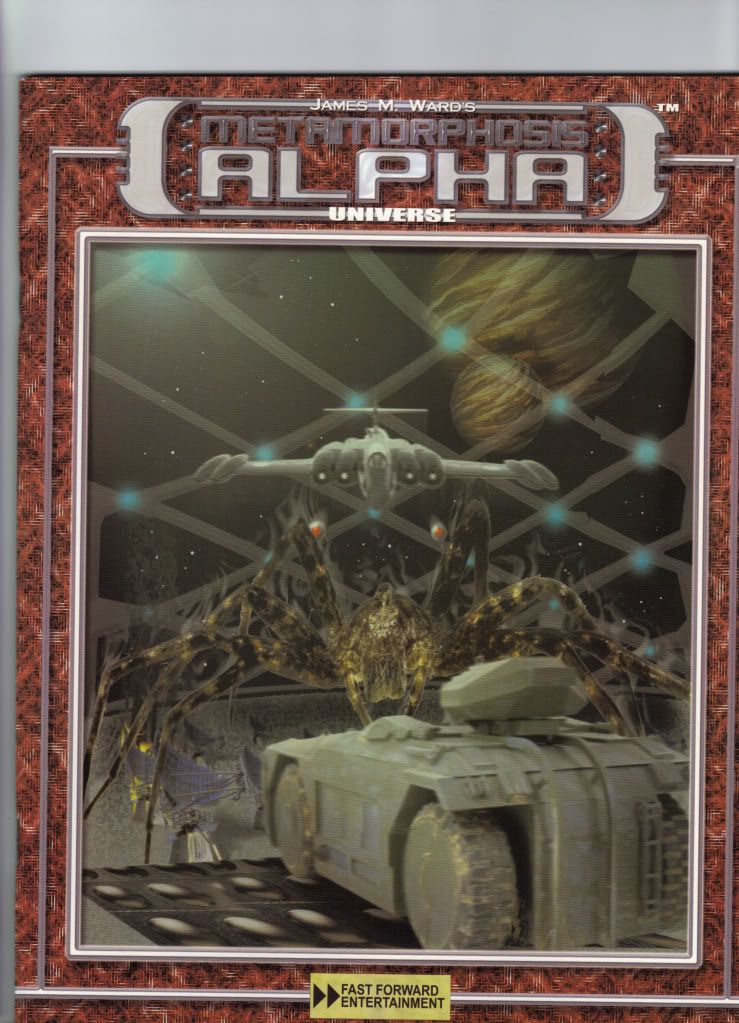
  • Metamorphosis Alpha Universe (MA 3rd edition)
  • Fight On! Issue 12
  • The Slayer's Guide to Kobolds
  • Dungeon Crawl Classics #12 The Blackguard's Revenge
  • Rotworld (printout)
  • Labyrinth Lord Module: Idol of the Orcs (printout)
  • Labyrinth Lord Module: Shadowbrook Manor (printout)
  • Excavator Monthly Issue 3 (printout)
Before getting this book, I never opened a MA book. I have the 1st edition rules, but its a shabby print-out booklet I put together from a text-only document I found years ago (without page numbers or art, its hard to navigate). The 3rd edition book has added rules that really compliment the classic rules, like how you can boost your Weapon Class with a particular type of weapon after 10 kills using them. I'm still not keen on the alien invasion twist - mostly as an unnecessary element - but it still a great game.

The biggest surprise was Fight On! Issue 12. For a game 'zine, it is THICK! This issue is dedicated to James M. Ward, and has an article about Ward's involvement in the early years at TSR. It is full of fantastic articles, but one of the featured rules I like the most is Treasure Types, by Simon Bull. I seen the original post mouths ago, but I lost the link. I find this method much better then the dry old Treasure Type table.

Rotworld was a neat surprise, as I did not know (or just forgot) that Dan Proctor made a zombie apocalypses/survival horror RPG. It seems to be based on a game Dan required called Timemaster (I never seen this game, but I did know about it). I'm not a fan of table-based systems or attributes that double as a percentile number, but I find a lot of useful stuff in this game.

I already have the Dungeon Crawl Classic module from a box set I found at a book store, and the Kobold book was one of the Slayer's books I do not already have.

I have yet to read the last three books, as I'm pouring through the aforementioned books. I also have to get more plastic sheet sleeves and binders, as the printouts are loose one-sided sheets. This is not a problem, as I already go through a lot of plastic sleeves & binders, do to my artwork and game stuff.

Its going to be a busy week or two for me, as I enjoy reading game books as much an regular literature, so I am happy! =D

Saturday, October 22, 2011

Pirates of Dark Water RPG

Back in the '90s, Hanna-Barbera produced a fantastic cartoon called The Pirates of Dark Water. This was a pirate-themed fantasy adventurers on the alien world of Mer. It had the look of an '80s cartoon, and the budding maturity of a '90s cartoon. If you have never seen this show, you have no idea what you been missing. As neat as the characters and stores were, the real draw to role-players is the setting and all the strange trapping there in.

Awhile back, I found a site with role-playing materials about the game. The funny thing is, it was a real RPG book. SOMEONE ACTUALLY MADE AN OFFICIAL ROLE-PLAYING GAME OF THE CARTOON, AND IT WAS ILLUSTRATED JAMES "FUCKING" HOLLOWAY!!! That is awesome, and yet, its not that well known. Its almost tragic, as it is full of strange and exotic stuff, and a grate diversion from all the bland old Tolkienesque dungeon crawls.

Well, I almost forgot about it after a big move, until I was going through by old backup files (I download and hoard so much shit), and I found the PDF source book. Here is the World Book, a download (no pictures), and the Monster Stats. I have to note that this is not a system I would personally use - if anything, its best to cherry-pick the rules to your own chosen game system.

I'm also going to contribute this added info to the Pirates of Dark Water Wiki.

Monday, May 2, 2011

I Just Won a Mutant Future Contest

Blood Axe at Goblinoid Games forum held a contest in the Mutant Future sub-forum.

The rules are simple:
  • "Post a cool character for Mutant Future with a picture and I will pick a winner."
  • "Enter as many times as you like, but have a character with all stats & info, along with a picture."
  • "[This] is only open to USA members."
Here is the prize:


Yes, a copy of Metamorphosis Alpha 25th Anniversary Edition.

I posted 6 entries, but this was the one Blood Axe liked:

Lergon, the "Many Hands"
Race: Mutant Human
Level: 6
Hit Points: 54
Armor Class: 6
THAC0: 15
Saves: Eng 13, P/D 10, Stun 12, Rad 11
Alignment: Chaotic

Attacks:
1/round, +0 to attack for melee and +1 to attack for missiles.
Damage: 1d6+1 w/spear or 1d4+1 w/daggers and 1d4 w/sling.

Strength: 11 (+1 level) (+0 to attack and +0 to damage)
Dexterity: 14 (+1 level) (+1 to missile attacks and initiative and -1 to armor class)
Constitution: 16 (+0 on poison saving throws)
Intelligence: 7 (-5% to technology; can write simple Trade words)
Willpower: 9 (+1 level)
Charisma: 7 (+1 level) (+1 to reaction rolls, 3 retainers at morale 6 each)

Mutations: Aberrant From - Extra Parts (8 arms); Bizarre Appearance (stubby arms - 3 baby-like), Control Light Waves; Greater Force Screen; Know Direction; Negative Empathy.

Equipment: Spear, 2 daggers, shield, sling w/20 stones, fur armor, bedroll, flint & steel, grappling hook, lantern, small steel mirror, 5 flasks of oil, 5 weeks of trail rations, 4 small sacks, 2 large sacks, 3 waterskins (2 water, 1 wine), 16 soup mixes, 7 light sticks, motion detector, 4 blood agent grenade launcher shells, 97 gp worth of assorted coins and scrap metal.

Lergon is a many-armed mutant with few friends. From a young age, he was an outcast of his tribe, so he had learned to survive on his own, and for it, he never developed a personality. The impulse that drives other to fight him, also makes him vary paranoid, and for the most part, he keeps quiet and introverted around others. When he do speak, its usually simple, short statements in Trade speak - a form of "Pidgin English". Beyond his emotional distance to others, he strongly desired to be loved. If he finds someone to love, who can tolerate his negative empathy, he would handle the relationship with obsession and petty jealousy. In his travels, he did befriend some adventures, but his impulsive behavior around women tend to cut things short.
________

He told me that "[he] captured that old school Gamma World feeling for me." I glad, as this is how I present characters in my games. I like my mutants to look freakish (Bizarre Appearance is a given in my games). I like them to be somewhat primitive (but not necessarily simpleminded). With PCs or NPCs, I like to make well-rounded characters, with personality traits and interesting character flaws.

By the way, the picture I chosen was from a french animated movie called Gandahar (or Light Years, in the US). This movie has a number of unique looking mutants, that are perfect for any Metamorphosis Alpha, Gamma World, or Mutant Future game. Here are more pics, if anyone is interested.